.png)


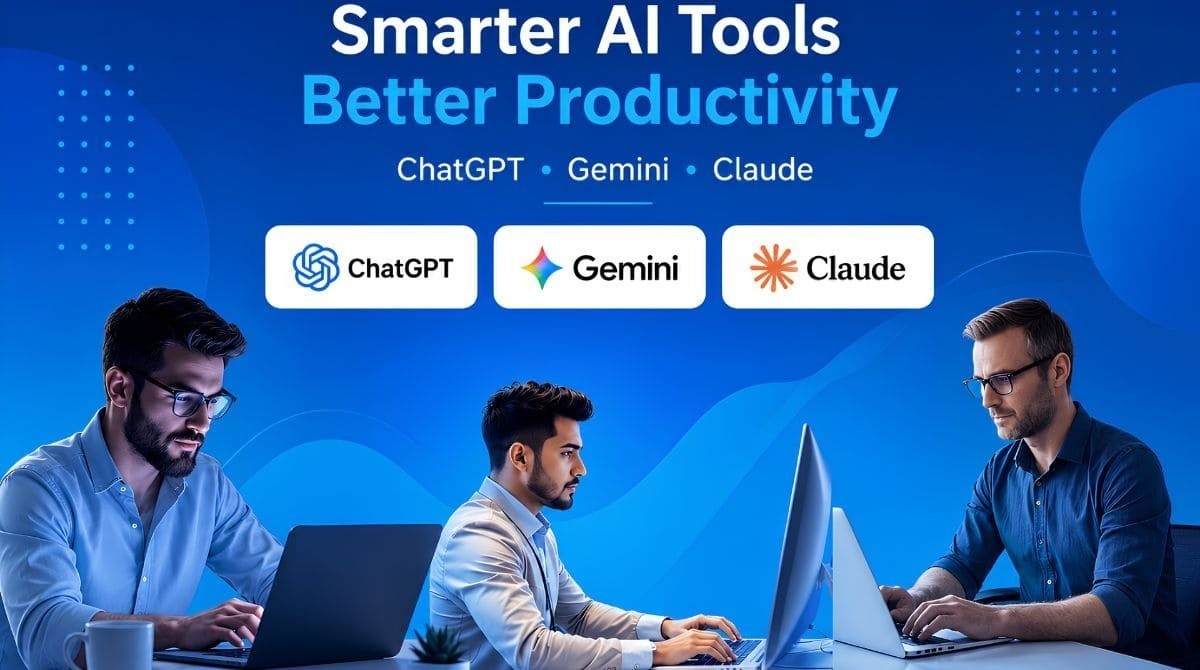
The conversation around
Artificial Intelligence has shifted dramatically. It is no longer a futuristic
aspiration confined to Silicon Valley boardrooms. Today, a textile manufacturer
in Surat, a real estate agency in Pune, a D2C skincare brand in Bengaluru, and
a mid-sized IT services company in Hyderabad are all actively evaluating the
same question: which AI tool will actually move the needle for my business? The
three platforms dominating this conversation are Open AI's ChatGPT, Google's
Gemini, and Claude. Each is powerful. Each has a distinct personality and set
of strengths. And choosing the wrong one can cost you far more than a
subscription fee it can cost you time, output quality, and competitive
advantage.
This article is
not a surface-level feature checklist. It is a frank, expert assessment of how
these three AI platforms perform across the specific workflows, budget
sensitivities, language requirements, and business contexts that are uniquely
relevant to the Indian market. Whether you are an entrepreneur scaling your
first product, a marketing head at a growing SME, or a CTO evaluating AI
infrastructure, this guide is designed to give you a clear-eyed view of where
each tool excels and where it falls short.
Why Indian Businesses Need a Different Lens for This
Comparison
Most
global AI comparisons are written with Western enterprise contexts in mind
large HR budgets, English-first workforces, and access to seamless integrations
with tools like Salesforce or HubSpot. Indian businesses operate in a
fundamentally different reality. There is significant linguistic diversity
across operations, a sharp sensitivity to cost-to-value ratios, a heavy
reliance on WhatsApp-based communication, and a growing need to produce content
that resonates with audiences across Tier 1, Tier 2, and Tier 3 cities
simultaneously. Beyond these structural differences, Indian businesses in 2026
are at a fascinating inflection point. Digital marketing in India has matured rapidly, and the companies
that are winning are those that have integrated AI into their content
pipelines, customer communication, lead generation workflows, and data analysis
processes. The AI tool you choose is not just a productivity add-on it is
increasingly the engine beneath your entire growth strategy.
ChatGPT: The Veteran That Became the Default
OpenAI · GPT- 4o & Beyond
When most Indian business
owners think of AI, they think of ChatGPT. That name recognition is not
accidental Open AI invested heavily in building the world's most visible AI
brand, and it worked. ChatGPT's GPT- 4o model is genuinely capable, with strong
multimodal abilities that allow it to process text, images, audio, and
documents in a single conversation. For a digital marketing team running SEO campaigns, the ability to upload a
competitor's PDF report and ask for a strategic counter-analysis in seconds is
a genuine superpower.
Where ChatGPT
particularly shines for Indian businesses is in the breadth of its plugin and
integration ecosystem. The ChatGPT App Store has thousands of third-party
plugins, including tools for e-commerce analytics, social media scheduling, and
even rudimentary CRM functionality. For companies that operate lean teams and
cannot afford enterprise software stacks, this extensibility can be
transformative. Additionally, ChatGPT's code interpreter feature is extremely
useful for entrepreneurs who need to run quick data analysis on sales CSVs,
understand their Google Ads performance data, or build simple automation logic
without a developer. However, ChatGPT is not without its limitations in the
Indian context. Its knowledge of regional Indian languages while improving is
inconsistent across dialects and writing styles. More critically, ChatGPT tends
to produce confident-sounding output that sometimes trades accuracy for
plausibility, a tendency that AI researchers call "hallucination" For
Indian businesses that need to produce legally accurate content, precise
financial communication, or technically sound product documentation, this trait
requires constant human oversight. The pricing structure has also become a
recurring concern the GPT-4o tier comes with usage caps that can frustrate
heavy users running high-volume content marketing operations.
Google Gemini: The Search-Native Powerhouse with Local
Relevance
Google · Gemini 2.0
& Ultra
Google's Gemini
represents something categorically different from its competitors: it is an AI
built inside the world's most comprehensive information infrastructure. The
strategic advantage here is difficult to overstate. When you use Gemini for
business research, you are not working with a model that was trained on a
static dataset and supplemented with a web search bolt-on. You are working with
a system that is deeply integrated with Google Search, Google Workspace, Google
Ads, YouTube, and Google Analytics. For Indian businesses that are already
living inside the Google ecosystem and the vast majority are this integration
layer is a powerful accelerant.
Consider a practical
scenario that plays out every day in Indian Google Ads management. A marketing manager
wants to understand why a particular campaign's click-through rate dropped last
week, correlate it with a competitor's new ad copy, and then draft three new ad
variants to test. With Gemini integrated directly into Google Ads, this entire
workflow can be compressed into a single session. The AI understands the native
language of your campaign data, suggests keyword refinements based on live
search trends, and drafts ad copy that is already calibrated to Google's
quality score parameters. ChatGPT can do parts of this. Gemini does it
natively.
Gemini's performance on
Indian languages is also meaningfully stronger than its competitors,
particularly for Hindi, Tamil, Telugu, Marathi, and Bengali. This has direct
implications for businesses building content strategies that target non-English
audiences a demographic that represents hundreds of millions of potential
customers across India. For social media marketing
campaigns that need to resonate in regional markets, the ability to
generate culturally attuned content in native languages is not a nice-to-have
feature; it is a fundamental business requirement.
The platform's weakness
lies in its creative and nuanced reasoning capabilities. Gemini tends to produce
content that is accurate, structured, and well-referenced, but it can feel
formulaic and lacks the distinctive voice that premium brand content requires.
For businesses whose competitive edge comes from thought leadership content,
sophisticated storytelling, or nuanced positioning, Gemini's outputs often
require more editorial refinement compared to its rivals.
Claude: The Precision Instrument That Enterprises Are
Quietly Adopting
Anthropic · Claude
Sonnet & Opus
Anthropic's
Claude has emerged as the preferred AI platform among professionals who work
with high-stakes written content legal drafting, technical documentation,
detailed analytical reports, complex business proposals, and long-form
research. The reasons for this preference are specific and worth understanding.
Claude was built with a foundational focus on what Anthropic calls
"Constitutional AI" a training methodology designed to make the model
less prone to confident hallucination and more inclined toward measured,
caveated reasoning when it encounters the limits of its knowledge.
For
Indian businesses operating in sectors like healthcare, legal services,
finance, and B2B technology, this distinction matters enormously. A financial
services firm in Mumbai does not need an AI that generates beautifully fluent
prose full of plausible-sounding figures that cannot be verified. It needs an
AI that produces careful, precise output and flags its own uncertainty.
Claude's Sonnet and Opus models consistently outperform competitors on complex
document analysis, multi-step logical reasoning, and tasks that require
maintaining coherence across extremely long contexts.
Claude's 200,000-token
context window is a particularly significant feature for Indian enterprises
that work with large volumes of documentation. A software development company reviewing a lengthy
technical specification, a law firm analyzing a multi-hundred-page contract, or
a business analyst synthesizing quarterly data across multiple reports these
are precisely the use cases where Claude's extended context capability becomes
a decisive advantage. The ability to upload an entire dataset or document
library and ask nuanced questions about it in natural language is genuinely
transformative for knowledge-intensive industries.
Where Claude shows
limitations is in its real-time web integration. Unlike Gemini, Claude does not
have the same depth of live search integration, and its ecosystem of
third-party plugins is thinner than ChatGPT's. For businesses that need an AI
deeply embedded in their real-time data environment tracking live market
conditions, monitoring competitor activity, or pulling live social media
sentiment Claude requires more structured workarounds. That said, for
businesses focused on deep analytical work, long-form content creation, and
enterprise-grade documentation, Claude's precision is unmatched.
The Practical Reality: Most Indian Businesses Should Not
Choose Just One
Here is the
insight that most comparison guides miss entirely: the most successful Indian
businesses in 2026 are not using a single AI platform exclusively. They are
deploying a layered AI strategy where different tools serve distinct functions
based on their specific strengths. A high-performing digital marketing agency in India might use Gemini for campaign
planning and Google Ads optimization, ChatGPT for rapid ideation and social
media content generation, and Claude for crafting detailed client proposals,
case studies, and long-form thought leadership content.
This is not an
argument for spending more on software. Most Indian SMEs can run highly
effective AI-augmented operations on the free or basic tiers of these
platforms. The point is about intentionality understanding what each tool does
best and routing the right tasks to the right model. A lead generation strategy that uses AI to personalize outreach emails, qualify
inbound leads via conversational AI, and generate weekly performance reports is
far more powerful than one that simply uses ChatGPT to write all of its content
in a generic, undifferentiated way.
Key Insight
for Indian Businesses
The businesses
generating the highest ROI from AI in India are not using the most expensive
plans they are using the right tool for each specific task, integrating AI into
clearly defined workflows, and measuring output quality with the same they
apply to any other marketing or operational investment.
The Human Layer That AI Cannot Replace
No comparison
of AI tools would be complete without addressing the limitation that is true of
all three platforms simultaneously. AI is a force multiplier for human strategy
not a substitute for it. The businesses that have been disappointed by AI are,
almost universally, those that deployed it without a clear strategy, without
quality control processes, and without the domain expertise needed to evaluate
the output critically.
A well-executed SEO strategy does not emerge from prompting ChatGPT to "write
me a blog post about digital marketing." It emerges from a deep
understanding of your audience's search intent, your competitive landscape,
your brand positioning, and your conversion funnel with AI used to accelerate
the execution of a human-designed strategy. Similarly, an AI-generated ad
campaign that is not evaluated by someone who understands your customers and
market will produce generic output that blends into the noise.
This is why the
most forward-thinking Indian businesses are not just buying AI tools they are
partnering with agencies and experts who understand how to integrate AI
strategically into end-to-end digital marketing and IT workflows. The tool is the enabler. The strategy
is the differentiator.
business Final
Verdict: Which AI Tool Wins for Indian Businesses? There is no single winner
but there is a clear guide for allocation based on type and function.
Choose ChatGPT
if You need a versatile, plugin-rich AI for content creation, customer support
scripting, rapid ideation, and light data analysis. Best for startups, D2C
brands, and content-heavy teams.
Choose Google
Gemini if You are deeply embedded in the Google ecosystem running Google Ads,
using Google Analytics, or needing strong regional language support. Best for
digital marketing teams and e-commerce businesses.
Choose Claude
if You need precision, nuance, and reliability for long-form documents, complex
analysis, technical writing, and enterprise-grade content. Best for IT firms,
legal, finance, and B2B companies.
The winning
formula for most Indian SMEs Gemini for Google ecosystem tasks + ChatGPT for
rapid content + Claude for high-stakes long-form work. Integrate all three into
a structured workflow and measure output quality consistently.
The AI
landscape will continue to evolve rapidly over the next 12 to 18 months, with
each of these platforms releasing new models, capabilities, and integrations at
a pace that makes today's comparison a living document rather than a final
answer. The businesses that stay ahead will be those that treat AI literacy as
an ongoing investment continuously testing, learning, and refining how they
deploy these tools across their operations.
If you want
help building an AI-integrated digital marketing strategy for your business one that combines the right tools
with the right expertise to drive measurable results get in touch with the Sirsonite team. We work with startups, SMEs, and
enterprises across India, the USA, UK, and Canada to build high-performance
digital ecosystems that are ready for the AI-first era.
Ready to Put AI to Work for Your
Business?
Sirsonite helps businesses across India and
worldwide integrate AI into their marketing, web development, and content
strategies. Let's build something that actually works.
Leave a Reply
Your email address will not be published. Required fields are marked *